AI Stocks, Micron Earnings & Trump AI Policy: Market Outlook
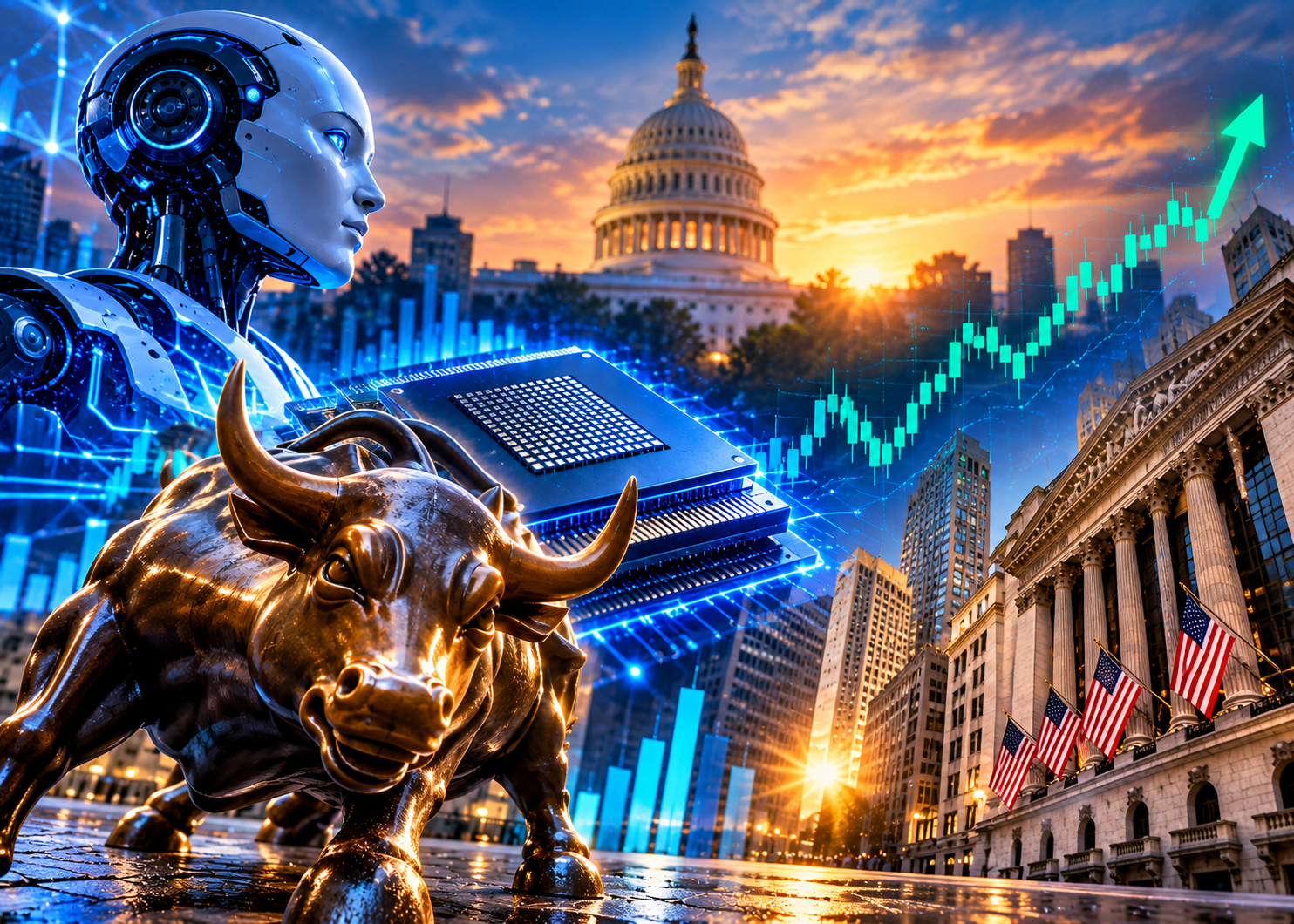
MARKET SETUP: AI DEMAND IS STILL STRONG, BUT RATES ARE THE COUNTERWEIGHT
The artificial-intelligence trade enters October with two powerful forces pulling in opposite directions. On the growth side, demand for AI computing, high-bandwidth memory and data-center infrastructure remains exceptionally strong. On the valuation side, long-term interest rates are elevated, raising the hurdle rate for expensive technology stocks and for the enormous capital projects needed to keep the AI buildout moving.
That tension is visible across global markets. Strong results from Micron Technology helped lift technology shares in Asia and supported U.S. equity futures, while the bond market remained under pressure. The key message for investors is that the AI demand story has not disappeared, but the cost of financing that growth now matters much more than it did during the first stage of the AI boom.
HEADLINE NO. 1: MICRON’S $32 BILLION SUPPLY COMMITMENTS REINFORCE THE AI MEMORY STORY
Micron Technology delivered one of the clearest recent signals that AI infrastructure spending is still translating into real semiconductor demand. The company said customer commitments under long-term supply agreements increased to about $32 billion, up from $22 billion in June. Micron also forecast quarterly revenue above Wall Street expectations as demand for high-bandwidth memory and other advanced memory products remains strong.
For the market, this matters well beyond Micron. High-bandwidth memory is a critical component in advanced AI accelerators, so tight memory supply can affect the entire AI hardware chain. Strong commitments suggest hyperscalers and AI infrastructure buyers are still planning years ahead instead of treating the current buildout as a short-lived spending burst.
The bullish interpretation is straightforward: AI demand is broad enough to support not only GPU vendors, but also memory producers, networking companies, optical suppliers, power equipment manufacturers and data-center operators. The risk is that investors may already be pricing in years of exceptional growth. If supply catches up faster than expected, or if customers slow capital spending, semiconductor margins and valuations could compress quickly.
HEADLINE NO. 2: TRUMP AND MAJOR TECH CEOS SIGN A VOLUNTARY AI SAFETY ACCORD
President Donald Trump announced a voluntary AI safety agreement with leaders from major technology and artificial-intelligence companies, including firms such as Nvidia, Google, Meta, OpenAI and Anthropic. The framework calls for internal controls, outside auditing and additional oversight of advanced AI systems. Because the agreement is voluntary rather than a binding federal regulatory regime, its immediate financial impact is likely to depend on how companies implement the commitments and whether Washington later converts parts of the framework into formal rules.
From an investor perspective, the accord cuts both ways. A lighter regulatory structure can reduce the risk of sudden restrictions that slow model development or data-center deployment. At the same time, independent audits, cybersecurity controls and safety testing create additional compliance costs. For the largest technology firms, those costs may be manageable and could even strengthen competitive barriers because smaller AI companies have fewer resources to absorb them.
The larger policy signal is that Washington continues to treat AI leadership as an economic and strategic priority. That supports the long-term case for domestic compute capacity, semiconductor manufacturing, energy infrastructure and secure data centers. But political support for AI does not eliminate the financial risks associated with overbuilding, debt-funded expansion or disappointing returns on capital.
HEADLINE NO. 3: TRUMP’S TRADE AGENDA REMAINS A MAJOR MARKET VARIABLE
The Trump administration is also continuing to press its tariff-centered trade strategy, with U.S. officials urging major economies to address industrial overcapacity, subsidies and trade practices associated with China. For markets, tariffs remain important because they can affect inflation, manufacturing costs, corporate margins and interest-rate expectations.
The AI sector is particularly exposed to trade policy because its supply chain crosses multiple countries. Advanced chips, memory, networking hardware, optical components, server equipment and power systems are produced through a global manufacturing network. Policies that encourage more U.S. production could benefit domestic factories and capital spending over time, but tariffs and supply-chain restrictions can raise near-term costs.
Investors should therefore separate two questions. First: is AI demand strong? Current evidence from memory and infrastructure spending says yes. Second: can that demand convert into attractive shareholder returns after financing costs, tariffs, energy costs and massive capital expenditures are included? That question is still open.
THE BOND MARKET MAY BE THE MOST IMPORTANT AI INDICATOR RIGHT NOW
Even with strong AI earnings, rising Treasury yields can pressure technology valuations. Higher yields increase the discount rate applied to future earnings, which tends to hurt companies whose valuations depend heavily on profits expected many years from now. They also increase borrowing costs for data centers, utilities, cloud providers and other capital-intensive businesses.
This creates a market where good AI news may not automatically produce broad stock gains. A company can report excellent demand and still trade poorly if investors become more concerned about rates, leverage or valuation. That is why the next stage of the AI trade may be more selective than the first. Companies with visible cash flow, strong balance sheets, pricing power and real customer commitments may be treated differently from companies whose valuations rely mainly on future AI expectations.
WHAT INVESTORS SHOULD WATCH NEXT
The next major signals are likely to come from four areas. First, watch additional semiconductor and cloud earnings for confirmation that AI capital expenditures remain firm. Second, watch high-bandwidth memory pricing and supply, because memory has become one of the clearest bottlenecks in advanced AI systems. Third, watch the 10-year Treasury yield: another sustained rise would increase valuation pressure across growth stocks. Fourth, watch how the Trump administration develops its AI and trade policies, particularly any move from voluntary standards toward binding regulation or new restrictions affecting technology supply chains.
The broader conclusion is not that the AI boom is ending. Current demand indicators remain strong. The more important shift is that investors are being forced to judge AI companies on financial durability as well as technological promise. Revenue growth, customer commitments, free cash flow, debt exposure and the cost of capital are becoming just as important as headline AI announcements.
BOTTOM LINE
AI remains one of the strongest structural investment themes in the market, and Micron’s latest supply commitments provide fresh evidence that demand for the hardware behind artificial intelligence is still substantial. At the same time, President Trump’s new voluntary AI safety framework and continuing trade agenda add another layer of policy risk and opportunity.
For investors, the setup is increasingly two-sided: powerful AI demand on one side, and elevated rates, expensive valuations, regulatory uncertainty and enormous capital requirements on the other. The strongest opportunities may come from companies that can prove they are converting AI demand into durable cash flow rather than simply participating in the spending boom.
SEO KEYWORDS
AI stocks, artificial intelligence stocks, Trump AI policy, Donald Trump AI, Micron earnings, Micron Technology, MU stock, Nvidia, NVDA stock, AI data centers, AI infrastructure, HBM memory, high bandwidth memory, semiconductor stocks, chip stocks, AI safety pact, technology stocks, Treasury yields, stock market news, finance news, market outlook, AI investment, data center spending, AI regulation, Trump tariffs
SOURCES
- Reuters — Micron's AI-fueled revenue forecast blows past estimates, backlog swells
https://www.reuters.com/business/micron-forecasts-quarterly-revenue-above-estimates-2026-09-30/
- Reuters — Tech stocks boosted by Micron but Treasury rout hangs over markets
https://www.reuters.com/world/china/global-markets-global-markets-2026-10-01/
- Reuters — Trump, AI CEOs sign voluntary safety pact, back data center expansion
https://www.reuters.com/legal/government/trump-host-zuckerberg-anthropics-amodei-other-ai-titans-tuesday-2026-09-29/
- AP — Trump says top tech firms have signed accord to 'self-police' AI development
https://apnews.com/article/595796511f110fc006cca0d01329733e
- Reuters — Greer urges G20 to back Trump tariff agenda, takes aim at China
https://www.reuters.com/world/china/greer-urges-g20-back-trump-tariff-agenda-takes-aim-china-2026-10-01/
Lock In Your Lifetime Subscription
Get full access to Candid Beach Galleries, exclusive content, new releases, and the complete archive with a lifetime subscription.