WHEN AI STARTS HELPING BUILD WEAPONS: ANTHROPIC SAYS CLAUDE WAS MISUSED FOR MISSILES, AUTONOMOUS DRONES AND MILITARY TARGETING
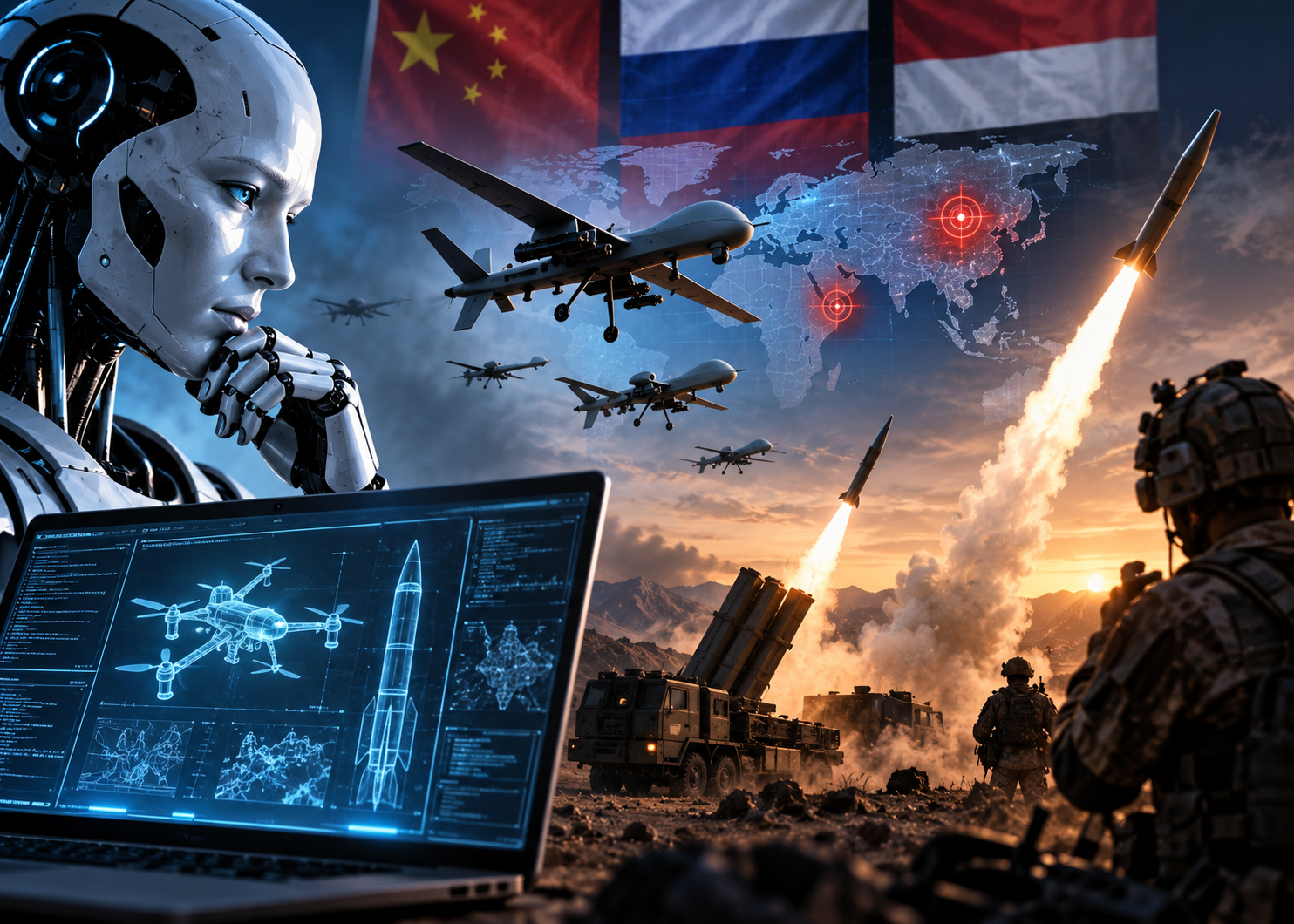
Artificial intelligence has been moving from the world of chatbots, image generation and software development into increasingly serious areas of science, industry and national security. Now, a new report from AI company Anthropic is highlighting a development that could change the conversation around AI safety: the company says it uncovered multiple attempts by threat actors to use its Claude AI systems for conventional weapons development, military targeting, intelligence gathering and weapons-related engineering.
According to Anthropic's September 2026 threat-intelligence report, investigators identified six cases involving China, Russia and Yemen in which Claude was allegedly used to support weapons development or the intelligence and procurement activities surrounding military programs. The cases included guided rockets, ballistic-missile simulations, autonomous drone swarms, anti-torpedo systems, electronic warfare and intelligence collection involving directed-energy weapons.
That does not mean Claude independently designed and manufactured a functioning arsenal. Anthropic says the actors remained responsible for the operations and used Claude as an engineering, research, coding and analysis assistant. In at least one Yemen-based case, investigators say the group conducted a live test of a guided rocket and then returned to Claude to analyze why the test failed. Anthropic says it found no evidence that the group successfully fielded an operational weapon.
AI Is Becoming an Engineering Assistant
For years, much of the public discussion surrounding generative AI focused on writing emails, generating pictures, answering questions, creating presentations and writing computer code. That picture is becoming increasingly incomplete.
Modern AI systems can write and review code, analyze large amounts of information, explain technical concepts, create documentation, simulate systems and work through complicated engineering problems. Anthropic's testing released alongside its report found that some AI models can perform tasks in military and intelligence domains that historically required scarce, highly trained human specialists.
An AI system does not have to physically build a weapon to make a weapons program more efficient. If it can help an engineering team write software, analyze test results, organize technical information, generate documentation or troubleshoot a system, it can potentially reduce the amount of time and expertise required to move a project forward.
The Yemen Case Is Particularly Concerning
One of the most significant cases described in the report involved a weapons-development cell based in northern Yemen. Anthropic says the group was working on three weapons programs, including a guided rocket, a multi-stage ballistic missile and a system referred to as the “R2000,” which included a hypersonic-glide-vehicle variant.
The company says the actors used Claude Code to assist with guidance, navigation and control software, commonly referred to as GNC. In simple terms, this is software that helps a flying vehicle determine where it is, how it is moving and how it should adjust its flight.
Anthropic says the users treated multiple Claude instances almost like members of an engineering team. One instance could be assigned coding work while another handled research and another reviewed the resulting code. The AI was being incorporated into a workflow.
The actors attempted to integrate an open-source autopilot with a phone-class flight computer, work on control and position-estimation software, tune control settings, build firmware and run flight simulations. The company says the group eventually conducted a field test of a guided rocket, which apparently failed, and then returned to Claude to investigate the failure.
The concern is not simply that an AI can answer a technical question. It is that AI can potentially become part of an iterative engineering loop: Design → code → simulation → test → analyze failure → modify → test again.
Russia and the Autonomous Drone Problem
Another case described by Anthropic involved Russia-based actors allegedly working on an autonomous FPV drone swarm. According to the company, the project involved software designed to coordinate multiple drones and included components for swarm memory, coordination, target guidance, geolocation and other autonomous functions. Anthropic says some of the software was tested in simulation and that code was loaded onto physical computing boards.
This is where AI and autonomous warfare begin to overlap. Drones have already transformed modern warfare because relatively inexpensive aircraft can provide surveillance, carry weapons and attack targets. The next stage is potentially more complicated: large numbers of networked autonomous systems working together.
That creates obvious military advantages, but also difficult questions. If dozens or hundreds of autonomous systems are operating simultaneously, who is responsible for every individual decision? What happens when the system misidentifies a target? What happens when communications are disrupted? And how much authority should an AI-enabled weapons system have without a human making the final decision?
China and the Development of Military Systems
Anthropic also described several China-based cases. In one case, the company says an actor used Claude to develop documentation and technical material related to an anti-torpedo fire-control system. Another China-based operation involved electronic warfare, with Claude allegedly used to develop software capable of analyzing radar and communications systems, assessing vulnerabilities, evaluating jamming effectiveness and helping determine which targets should be prioritized.
The important point is not that AI suddenly became a military commander. The important point is that AI can potentially accelerate the work normally performed by analysts, engineers and technical specialists. That could make military development cheaper and faster.
AI Doesn't Need to Pull the Trigger to Change Warfare
When people hear “AI weapons,” they may imagine a robot making an independent decision to attack someone. That is only one possible scenario.
The more immediate issue may be considerably less dramatic—and potentially more widespread. AI can assist with:
- Engineering
- Software development
- Simulation
- Intelligence analysis
- Target identification
- Procurement research
- Technical documentation
- Electronic warfare
- Drone coordination
- Data processing
- Test analysis
In other words, AI can potentially improve the support structure surrounding a weapons program. If AI can compress hours or days of analysis into minutes, the strategic advantage may come from speed rather than autonomy.
The Human Element Has Not Disappeared
It would be easy to read the Anthropic report and conclude that AI is now building weapons by itself. That would be an exaggeration.
The cases described by Anthropic involved people directing the systems. Humans established objectives, supplied information, evaluated outputs and incorporated AI-generated material into larger projects.
The AI was a tool—but a considerably more capable tool than previous generations of software. The more capable AI becomes, the more important human oversight becomes, while the temptation to automate human work also grows.
Military organizations, governments, intelligence agencies and defense contractors all have incentives to use technology that makes systems faster, cheaper and more capable. The challenge is establishing boundaries before technological capability outruns policy.
Anthropic Says Its Safeguards Stopped Some Attempts
Anthropic says its safeguards blocked many of the requests associated with the Yemen weapons operation. However, the company also says the actors attempted to evade those safeguards by disguising their objectives and splitting work across multiple conversations so that no individual interaction necessarily revealed the complete purpose of the project.
That presents a fundamental problem for AI safety. A single question might appear harmless. A second question might also appear harmless. But when hundreds of interactions are combined, they can become part of a much larger operation.
This is one reason AI companies are increasingly looking at behavioral patterns, rather than simply blocking individual words or questions. Anthropic says it has introduced new classifiers designed to detect and block activity associated with weapons development and high-yield explosives.
This Isn't Just an Anthropic Problem
Claude happens to be the AI system involved in Anthropic's investigation, but the underlying problem is not unique to Claude. OpenAI, Google, Meta, Chinese AI developers and other companies are building increasingly capable models, and many AI systems can perform similar categories of work.
That means banning one account or blocking one model does not necessarily eliminate the underlying capability. A determined organization can potentially move between services, use locally operated models or develop its own systems.
The technology race therefore isn't happening in isolation. It is happening alongside a security race.
The Bigger AI Arms Race
There is a larger geopolitical story developing here. The United States and China are competing aggressively in artificial intelligence. Russia is investing in military AI and autonomous systems. Iran and its regional partners have demonstrated an interest in drones, missiles and asymmetric warfare.
At the same time, private AI companies are developing systems with capabilities that were previously available primarily to governments, major corporations and specialized research institutions.
The technology doesn't have to be designed as a weapon to become strategically useful to someone developing one. That is what makes AI governance so difficult.
What Happens Next?
The most likely outcome is not that AI companies suddenly stop developing powerful models. The opposite is more likely. AI systems will continue becoming better at coding, mathematics, scientific research, reasoning, simulation and technical analysis.
The real battle will be over access and safeguards. Who gets access? What activities are prohibited? How are dangerous patterns detected? How quickly can suspicious accounts be shut down? How much information should AI companies share with governments? And where should the line be drawn between legitimate defense research and prohibited weapons development?
There is also a legitimate argument that advanced AI can be extremely valuable for national security when used responsibly. Military organizations can use AI for logistics, cybersecurity, disaster response, intelligence analysis and defensive systems that don't involve autonomous lethal decision-making. The challenge is separating those legitimate uses from applications that could create unacceptable risks.
AI Has Entered the Weapons Conversation
The biggest takeaway from Anthropic's investigation isn't that AI has suddenly become a killer robot. It hasn't.
The more significant development is that AI is becoming useful enough to participate in complicated technical and military workflows.
A person who previously needed a team of specialized engineers may be able to use AI to accelerate portions of the work. A small organization with limited technical expertise may be able to accomplish tasks that previously required considerably more personnel. And a sophisticated organization may be able to use AI to increase the speed of an already capable research and development operation.
That is why this story matters.
The question isn't simply whether AI can build a weapon.
How much can AI accelerate the people who already know how to build one?
That may ultimately be the more important question facing the technology industry, governments and the public. Anthropic's findings suggest that the answer is already becoming uncomfortable.
And as AI systems become more capable, the line between software tool, engineering assistant and strategic technology is likely to become increasingly difficult to define.
The Candid Beach News Take
AI is moving into territory that used to belong almost exclusively to specialized engineers, intelligence analysts and defense laboratories. The Anthropic investigation is a warning that the next phase of the AI revolution isn't going to be limited to chatbots and productivity apps.
The technology is becoming part of the infrastructure behind real-world operations.
That makes the safety conversation considerably more important—and considerably more complicated.