Your Groceries Cost More — So Why Does It Feel Like Everything Is Getting Recalled?
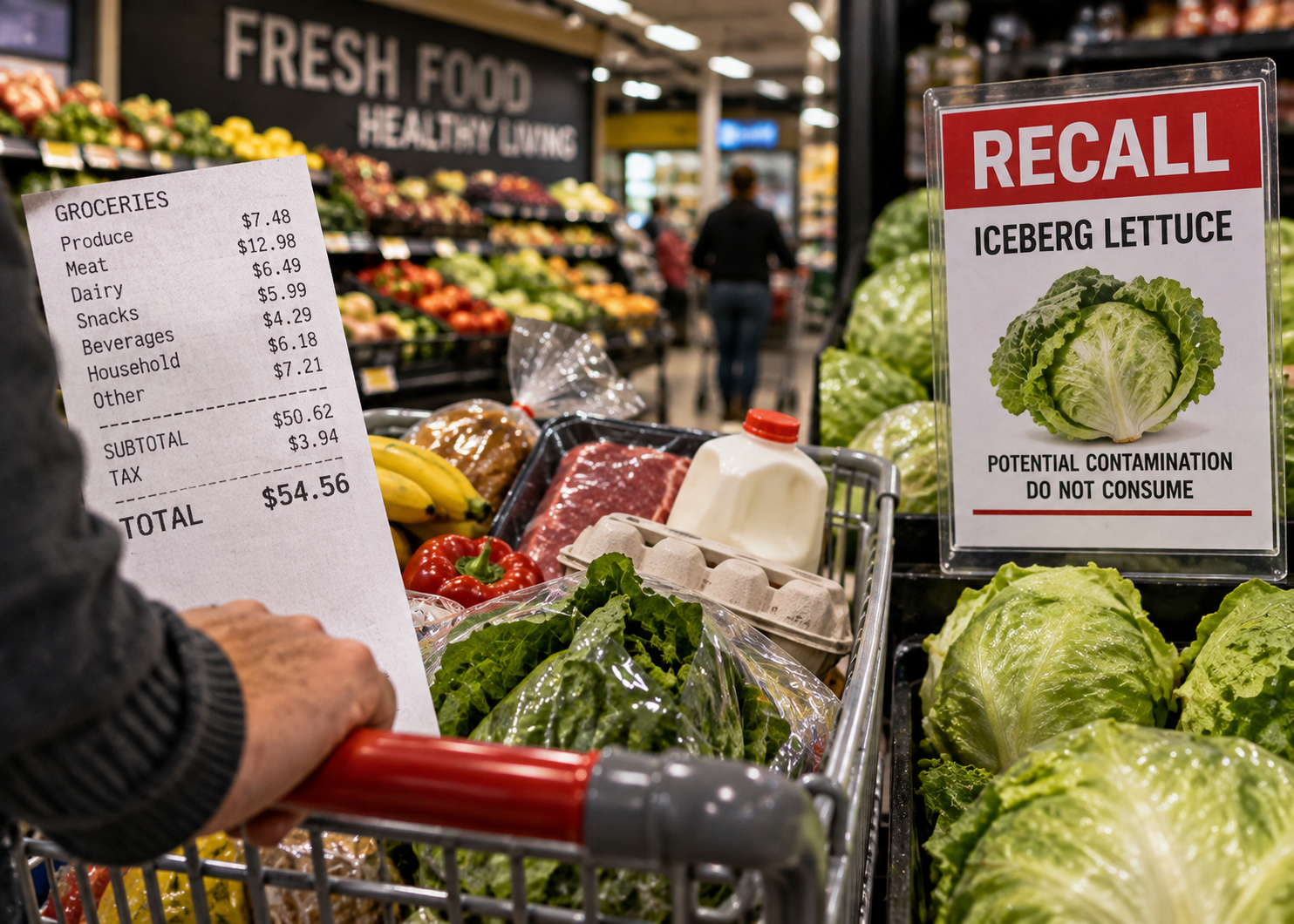
Americans are paying more for food, but lately there's another problem waiting for shoppers after they get through the checkout line: Is the food they're buying actually safe? Grocery prices remain elevated, restaurants aren't getting any cheaper, and food recalls and outbreak investigations continue appearing in the news. Federal data showed food prices running about 3% higher than a year earlier in July, with groceries purchased for the home up 2.7%. Some individual foods have increased considerably more. At the same time, the FDA's 2026 public-health advisories have included outbreaks involving lettuce, eggs, jalapeños, sprouts, frozen blueberries, cheese and other products. That doesn't mean the entire American food supply is unsafe, but when consumers are already spending more at the supermarket, repeated headlines involving Salmonella, E. coli, Cyclospora and Listeria can understandably leave people wondering exactly what is happening to their food.
The Massive Lettuce Outbreak Is Finally Over
One of the biggest food-safety stories of the year reached an important milestone today. U.S. health officials declared the enormous Cyclospora outbreak associated with iceberg lettuce over after nearly 13,000 reported illnesses. The final count was 12,883 illnesses across 21 states, including 570 hospitalizations and two deaths. The contaminated lettuce was traced through the supply chain to lettuce sourced from central Mexico, and officials say the affected product is no longer on the market. The investigation into exactly how the contamination entered the food supply, however, continues.
The scale of the outbreak is what makes this story particularly significant. This wasn't a few dozen people getting sick after eating at the same restaurant. Thousands of illnesses were spread across numerous states, demonstrating how quickly a contamination problem can expand when food moves through a large modern distribution network.
That's one of the realities of America's food system. The same distribution infrastructure that allows consumers in California, Michigan, Florida and New York to buy fresh produce throughout the year can also allow contaminated food to travel enormous distances before anyone realizes there's a problem.
A farm doesn't necessarily sell directly to your neighborhood supermarket. Food can move through growers, processors, packing facilities, distributors, transportation companies, restaurant suppliers and retailers before reaching your plate.
When everything works properly, that system is remarkably efficient.
When something goes wrong, the scale can become enormous.
And Now There's Another Sprout Investigation
Even as the lettuce investigation winds down, federal officials are dealing with another produce-related outbreak.
The FDA and CDC are investigating a multistate Salmonella outbreak linked to broccoli sprouts grown by Evergreen Fresh Sprouts LLC in Idaho. As of the latest federal update, 22 illnesses had been reported across four states, with two hospitalizations and no deaths.
The recalled broccoli sprouts have specific expiration dates extending through September 16, and confirmed distribution included Idaho, Montana and Washington, although officials have warned that additional distribution may have occurred.
This outbreak is particularly useful for understanding why sprouts can present food-safety challenges. Sprouts are grown in warm, moist conditions—the same type of environment that can also encourage bacterial growth if contamination is present. Because many sprouts are eaten raw or only lightly cooked, there may not be a cooking step capable of killing harmful bacteria before they're consumed.
Federal officials aren't telling Americans to stop eating vegetables. They are telling consumers to pay attention to specific products, brands, dates and official recall notices rather than assuming every item in a particular category is dangerous.
That distinction matters.
Why Does It Feel Like Everything Is Being Recalled?
Scroll through food news long enough and it can seem like half the supermarket is under investigation.
The FDA's 2026 public-health advisories alone have included incidents involving sprouts, jalapeños, eggs, iceberg lettuce, frozen blueberries, powdered infant formula, soft cheese, moringa products and raw cheddar cheese.
But more recalls don't automatically prove that food production itself has suddenly become dramatically less safe.
Part of what consumers are seeing is a combination of a massive food-distribution system and increasingly sophisticated disease detection.
Modern laboratories can identify genetic similarities between bacteria found in sick patients and bacteria recovered from food. Investigators can then combine laboratory evidence with interviews, purchasing records and supply-chain information to identify possible sources.
That means outbreaks that might once have appeared to be unrelated stomach illnesses in different states can potentially be connected.
In other words, sometimes we're not simply seeing more problems.
We're getting better at finding them.
That is actually a positive development—but it also means consumers hear about food-safety incidents far more quickly and frequently than previous generations did.
The Bigger Problem: One Supplier Can Reach Thousands of People
There is still a structural vulnerability that shouldn't be ignored.
America's food system operates at enormous scale.
Large growers, processors and distributors can supply products to grocery stores, restaurants and institutional kitchens across multiple states. That efficiency helps keep supermarkets stocked, but it also creates the possibility that a problem at one point in the supply chain can affect consumers hundreds or thousands of miles away.
Think about how differently food distribution works today compared with buying vegetables directly from a small local farm.
A large commercial operation might harvest huge quantities of produce. That food can then be combined, processed, packaged and distributed through multiple facilities before reaching numerous supermarket chains and restaurants.
If contamination happens early enough in that process, one problem can become everybody's problem.
And because fresh produce doesn't sit around for months, investigators are racing against time.
By the time enough people become sick to establish a pattern, some of the original food may already have been eaten or discarded.
That's why traceability has become such an important part of modern food safety.
Investigators need to know where the product originated, where it was processed, which distributor handled it, which businesses received it and when it reached consumers.
The faster that chain can be reconstructed, the faster contaminated products can potentially be removed.
Now Add Rising Grocery Prices
Food safety would be concerning enough by itself.
But consumers are dealing with it while food remains expensive.
Federal inflation data showed overall food prices up approximately 3% year-over-year in July. Grocery-store food was up about 2.7%, while restaurant food increased approximately 3.4%.
And those averages can hide much larger changes in individual products.
Consumers don't experience inflation as a government statistic. They experience it when they buy bread, meat, milk, cereal, produce and everything else required to feed a household.
That's why grocery inflation can feel particularly frustrating.
You can postpone buying a television.
You can keep an older car.
You can skip a vacation.
You can't stop eating.
Food occupies a unique position in the household budget because it's both essential and recurring. Even relatively small percentage increases become meaningful when they're repeated every week.
And there may now be another source of pressure coming through the supply chain.
$6 Diesel Could Eventually Reach Your Grocery Cart
Diesel prices have surged above $6 per gallon nationally, creating another potential headache for food producers and retailers.
Why should someone standing in a supermarket care about diesel?
Because America's food system runs on it.
Farm equipment uses fuel.
Produce has to leave farms.
Refrigerated trucks transport meat, dairy and vegetables.
Distribution centers receive shipments.
Trucks then move those products to supermarkets and restaurants.
Every step has a transportation cost.
When diesel becomes dramatically more expensive, trucking companies don't simply absorb those costs forever. Eventually some portion can move through the supply chain and reach wholesalers, retailers and consumers.
That doesn't mean a $6 gallon of diesel immediately makes your lettuce $2 more expensive tomorrow.
The process is more complicated.
Companies have contracts, hedging programs, different transportation arrangements and different abilities to absorb costs.
But sustained transportation inflation creates pressure.
And food is particularly exposed because so much of it has to move quickly.
A television can sit in a warehouse.
Fresh strawberries can't.
The Consumer Is Getting Hit From Multiple Directions
That's what makes the current food story bigger than any single recall.
Consumers are dealing with several forces simultaneously:
Food prices remain elevated.
Energy and transportation costs are increasing.
Large foodborne-illness investigations have damaged confidence in certain products.
Restaurants are dealing with higher operating expenses.
And households still have to eat.
That creates a frustrating situation where consumers may pay more for food while simultaneously feeling less confident about what they're buying.
The psychological impact matters too.
After repeated reports involving lettuce, sprouts, eggs, jalapeños and other everyday foods, people can begin treating the entire produce aisle as suspicious.
That's not the right response.
The better response is becoming a more informed consumer.
What Should You Actually Do?
Don't panic every time you hear the word "recall."
Instead, determine whether the recall actually applies to something you purchased.
Look for the brand, product name, package size, UPC code, lot number, expiration or use-by date and states where the product was distributed.
Those details matter because a recall involving broccoli sprouts from one grower doesn't mean every package of broccoli sprouts in America is contaminated.
The same principle applies to lettuce, eggs, cheese or virtually any other recalled food.
Consumers should also take official recall instructions seriously.
If the FDA or CDC tells consumers not to eat a specific recalled product, don't try to determine whether yours "looks okay."
Dangerous bacteria don't necessarily change the appearance, smell or taste of food.
Throw the affected product away or follow the recall instructions.
And if a recalled product has been stored in your refrigerator or touched kitchen surfaces, pay attention to official cleaning recommendations because cross-contamination can become another source of exposure.
The Real Issue Isn't Just Food Safety
There is a larger economic issue developing here.
Americans expect expensive products to provide something in return.
If you pay more for a car, you expect better features.
If you pay more for a hotel, you expect a better room.
If you're paying more for food, however, you're not necessarily getting anything different.
You're often buying the same eggs, vegetables, bread and meat you bought before—just at a higher price.
That's why combining grocery inflation with recurring food-safety headlines creates such a negative consumer reaction.
People aren't merely asking:
"Why is my grocery bill so high?"
They're beginning to ask:
"Why am I paying more while constantly hearing that something else has been recalled?"
Those are two separate problems, but from the consumer's perspective they're happening in the same supermarket.
The Bottom Line
America's food system isn't collapsing, and consumers shouldn't become afraid of buying fresh food. Millions of meals are eaten safely every day, and the ability of regulators and laboratories to detect outbreaks is itself an important part of protecting the public.
But the recent outbreaks expose vulnerabilities that deserve attention.
A highly interconnected food supply can distribute products efficiently across the country, but that same scale can magnify a contamination event. The massive iceberg-lettuce outbreak demonstrated exactly how large that problem can become.
At the same time, the economics aren't getting easier.
Food prices remain above last year's levels, and soaring diesel costs could create additional transportation pressure throughout the food supply chain.
Consumers therefore have every reason to expect two things from the companies and agencies responsible for America's food system:
affordable food and safe food.
Neither should be considered optional.
And when people are already paying more every time they walk into the supermarket, asking them to constantly check whether the food they just purchased has been recalled isn't exactly going to make them feel better about the bill.
Lock In Your Lifetime Subscription
Get full access to Candid Beach Galleries, exclusive content, new releases, and the complete archive with a lifetime subscription.